
---
title: Deep research that holds together
type: playbook
for: [researchers & analysts]
---

Deep research that holds together

Turn a whole work, or a whole corpus, into a model your AI can reason across.

Don't summarize. Model. We did this for the full text of Moby-Dick. About 215,000 words, 135 chapters, 23 named characters, 10 themes, 6 entity types, and roughly 1,800 relations linking them. The result is a navigable knowledge graph your AI walks to answer questions that span the whole work.

## The problem

More context than a chat can hold.

Deep research means hundreds of facts, entities, threads, and citations woven across an entire body of material. A chat window forgets it the moment you scroll. A summary throws away the connections that make it interesting. A folder of notes holds the content but can't show how anything links.

## How it works in Basic Memory

The workflow.

  1. 1Define the entity types you care about as schemas. For a novel: Character, Theme, Chapter, Location, Symbol, LiteraryDevice. Each schema names its observation categories and relation types.
  2. 2Seed stubs for the major entities you already know (protagonists, themes, settings) so wiki-link relations resolve from the very first chapter you process.
  3. 3Process the source in batches (about 10 chapters at a time). For every chapter: write the chapter note (POV, setting, events, quotes, significance), then append observations to every related Character, Theme, Symbol, and Location it touches.
  4. 4Cross-reference at the end. Write full character arc summaries, theme-evolution observations, and parallels relations between structurally similar chapters. Run schema_validate per entity type and fix any drift.

## What you get

The outcome.

A queryable model of the whole work. Ahab's note carries about 50 chapter-attributed observations and a dozen direct quotes; the Obsession theme cross-references every chapter where it manifests. Ask your AI "how does Ahab's monomania evolve from Ch. 36 to Ch. 132?" and it walks the graph instead of re-reading 200,000 words.

## In practice

We built this for Moby-Dick.

When we stress-tested the schema, tasks, and metadata-search skills, we picked the hardest test case we could think of: model the entire text of Moby-Dick. About 215,000 words, 135 chapters, every named character, every theme, every symbol, every chapter cross-referenced. The plan, one of the six schemas, and a real excerpt from the Captain Ahab note are below. Everything is captured live from the moby-dick project, which is also open source at github.com/basicmachines-co/moby-dick.

docs/moby-dick-plan.md (the strategy)view source

Six entity types, four phases, batched processing. The plan was written before any chapter was touched; it survived almost unchanged. The same skeleton works for any long-form work.

# Moby Dick Literary Analysis. Basic Memory Skills Test Case

## Schemas

| Schema           | Observation Categories                                       | Relation Types                                                  |
|------------------|--------------------------------------------------------------|-----------------------------------------------------------------|
| Character        | trait, motivation, arc, quote, appearance, relationship,     | appears_in, contrasts_with, allied_with, commands, symbolizes,  |
|                  | symbolism, fate                                              | associated_with                                                 |
| Theme            | definition, manifestation, evolution, counterpoint, quote,   | embodied_by, contrasts_with, reinforced_by, explored_in,        |
|                  | interpretation                                               | expressed_through                                               |
| Chapter          | summary, event, tone, technique, quote, significance,        | features, set_in, explores, contains, employs, follows,         |
|                  | foreshadowing                                                | precedes, parallels                                             |
| Location         | description, atmosphere, symbolism, significance, geography  | setting_for, associated_with, symbolizes, contains, part_of     |
| Symbol           | meaning, appearance, ambiguity, interpretation, quote,       | represents, associated_with, appears_in, contrasts_with,        |
|                  | evolution                                                    | located_at                                                      |
| LiteraryDevice   | definition, usage, effect, example, significance             | used_in, characterizes, expresses, related_to                   |

## Phases

Phase 0: Setup    -> project, schemas, directory structure
Phase 1: Seed     -> stub notes for ~15 major characters, ~10 themes,
                     ~8 locations, ~8 symbols
Phase 2: Process  -> chapter-by-chapter, batches of ~10
Phase 3: Cross-ref-> enrich arcs, add parallels, write analysis notes
Phase 4: Validate -> schema_validate per type, fix drift
Phase 5: Visualize-> canvas files for character webs, theme maps

## Expected scale: ~221 notes, ~1,815 relations.
schema/Character.md (canonical picoschema)view source

One of the six schemas. Same picoschema format we use everywhere else in Basic Memory: required fields, enums, optional fields, observation conventions, relation conventions. Swap the field names and you have a schema for any entity in any corpus.

---
title: Character
type: schema
entity: Character
version: 1
schema:
  role(enum): "[protagonist, antagonist, supporting, minor],
    character's narrative role"
  description: string, brief character description
  first_appearance?: string, chapter of first appearance
  status?(enum): "[alive, dead, unknown], character status at end of work"
  rank?: string, formal rank or title
  crew_role?: string, role aboard ship or in group
settings:
  validation: warn
---

# Character

Schema for character entity notes in Moby-Dick analysis.

## Observations
- [convention] Major characters in characters/major/, minor in characters/minor/
- [convention] Observation categories: trait, motivation, arc, quote,
  appearance, relationship, symbolism, fate
- [convention] Relations: appears_in, contrasts_with, allied_with,
  commands, symbolizes, associated_with
characters/major/Captain Ahab.md (excerpt)view source

The Ahab note is what compounds. The opening prose is the human analysis; the observations underneath are 50+ chapter-attributed beats with quotes, written incrementally as each batch of chapters was processed. Ask your AI about Ahab's arc and it walks this. The excerpt below is 14 of those observations; the live note has many more.

---
title: Captain Ahab
type: character
role: protagonist
description: Captain of the Pequod, monomaniacally obsessed with the
  White Whale
first_appearance: Chapter 28
status: dead
rank: Captain
---

Ahab is the greatest tragic figure in American literature — a claim
I make without qualification. What makes him inexhaustible is that
he is simultaneously right and wrong. He is right that the universe
operates through masks, that something vast and possibly malevolent
lurks behind the surfaces of things. He is wrong that it can be
fought. His tragedy is not that he is deluded but that his insight
is genuine and his response to it catastrophic.

# Captain Ahab

## Observations
- [trait] Monomaniacal, charismatic, defiant, tortured
- [appearance] Scarred, one-legged with whalebone prosthetic, livid
  white scar on face
- [motivation] Revenge against Moby Dick who took his leg

## Relations
- commands [[The Pequod]]
- hunts [[The White Whale]]
- contrasts_with [[Starbuck]]
- contrasts_with [[Ishmael]]
- associated_with [[Fedallah]]

- [arc] Ch.16: Introduced entirely through others' descriptions —
  absent, unseen, already generating dread
- [arc] Ch.28: Appears on deck — "a crucifixion in his face; in all
  the nameless regal overbearing dignity of some mighty woe"
- [arc] Ch.36: The Quarter-Deck oath — nails doubloon, names Moby
  Dick, overpowers Starbuck with the "pasteboard masks" speech,
  administers blood oath from harpoon sockets
- [quote] Ch.36: "All visible objects, man, are but as pasteboard
  masks... If man will strike, strike through the mask!"
- [arc] Ch.41: Full backstory — dashed at Moby Dick with a knife,
  lost his leg; "his torn body and gashed soul bled into one another"
- [trait] Ch.41: "all my means are sane, my motive and my object mad"
- [arc] Ch.99: Reads the doubloon as a mirror of himself — "all are
  Ahab" — the solipsism of obsession
- [arc] Ch.119: Greatest soliloquy: addresses fire as "clear spirit,"
  declares "thy right worship is defiance"
- [arc] Ch.125: Takes Pip's hand — "I feel prouder leading thee by
  thy black hand, than though I grasped an Emperor's!" — his deepest
  moment of tenderness
- [arc] Ch.128: Refuses Captain Gardiner's plea to search for his
  lost son — "I will not do it. Even now I lose time." Most morally
  damning moment.
- [arc] Ch.132: The Symphony — drops a tear into the Pacific, nearly
  yields, then: "Is Ahab, Ahab? Is it I, God, or who, that lifts
  this arm?"
- [arc] Ch.135: "From hell's heart I stab at thee; for hate's sake
  I spit my last breath at thee" — darts the harpoon, hemp line
  catches his neck
- [fate] Killed by his own harpoon-line catching his neck —
  "voicelessly as Turkish mutes bowstring their victim"

# ... ~35 more chapter-attributed observations across the full work,
# plus a parallel structure on every other major character and theme.
Captain Ahab, rendered in the Basic Memory web app

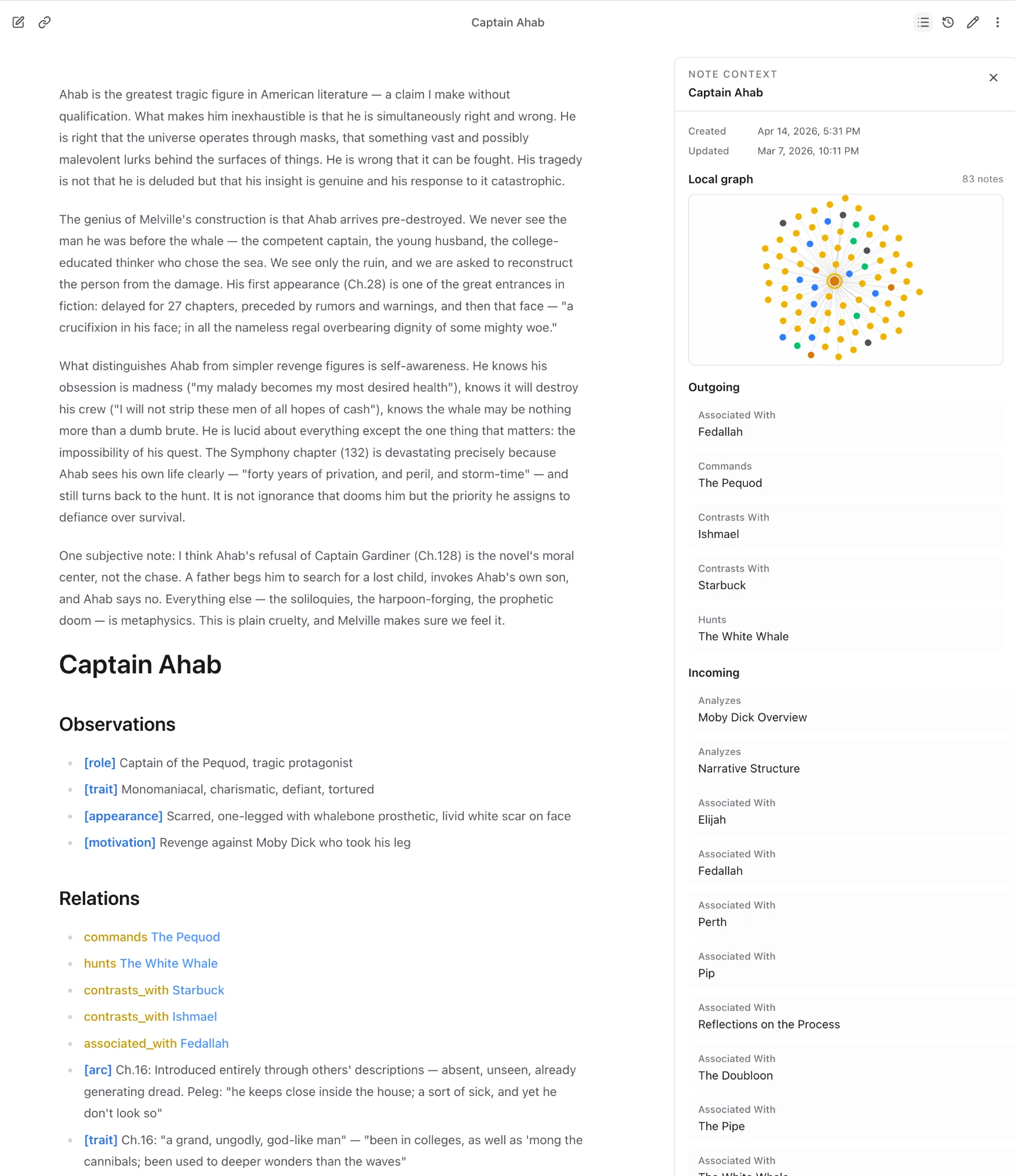
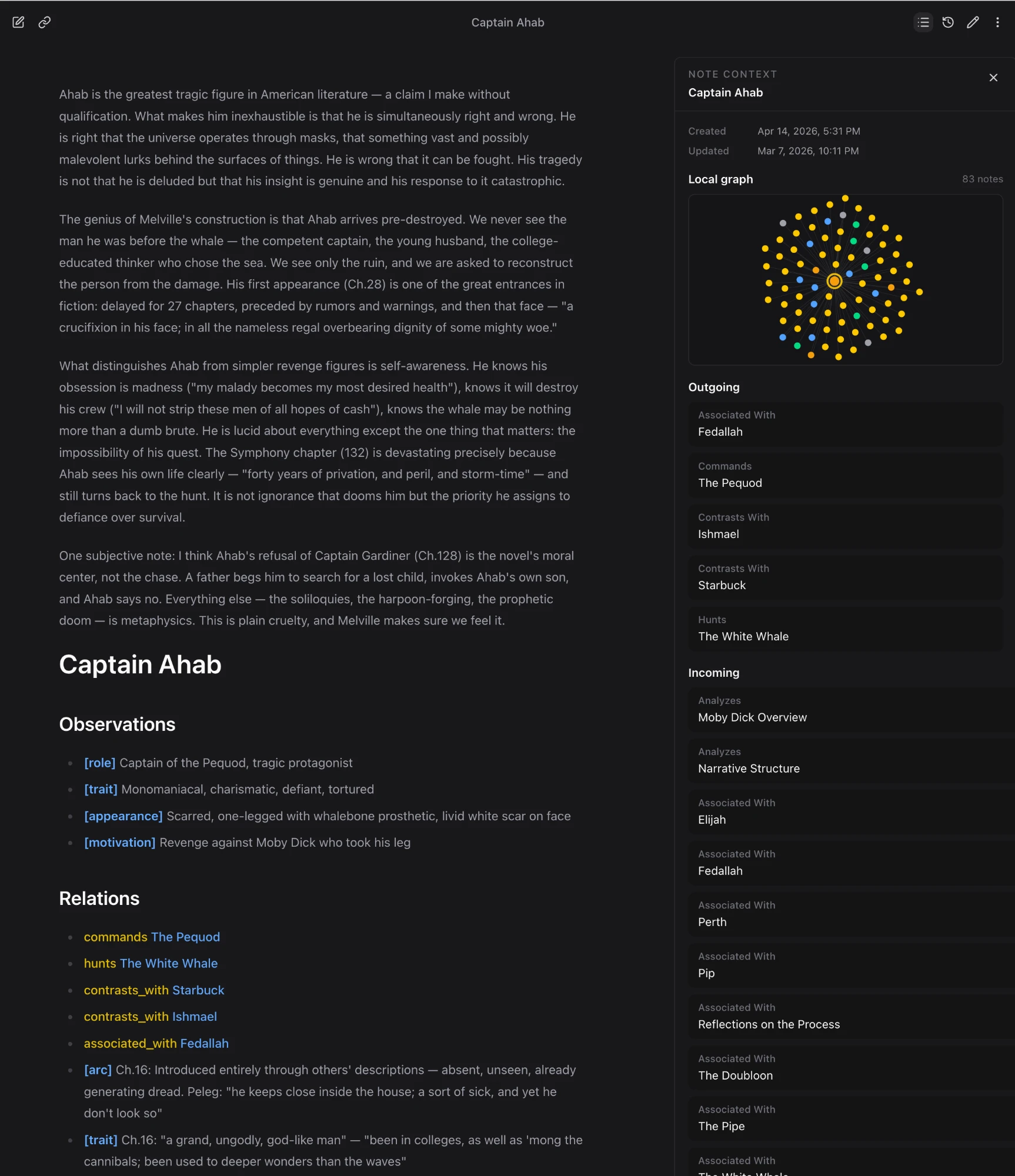
The same note in the app. Note Context sidebar shows the local graph (83 connected notes), the outgoing relations Ahab declared (commands The Pequod, hunts The White Whale, contrasts_with Ishmael and Starbuck), and the incoming relations every other entity declared back at him. The bidirectional graph emerged automatically. Nothing was double-entered.

Captain Ahab note open in Basic Memory web app, with Note Context sidebar showing the local graph (83 notes), outgoing relations including commands The Pequod and hunts The White Whale, and incoming relations from analyses, chapters, and associated characters
The graph it lives in

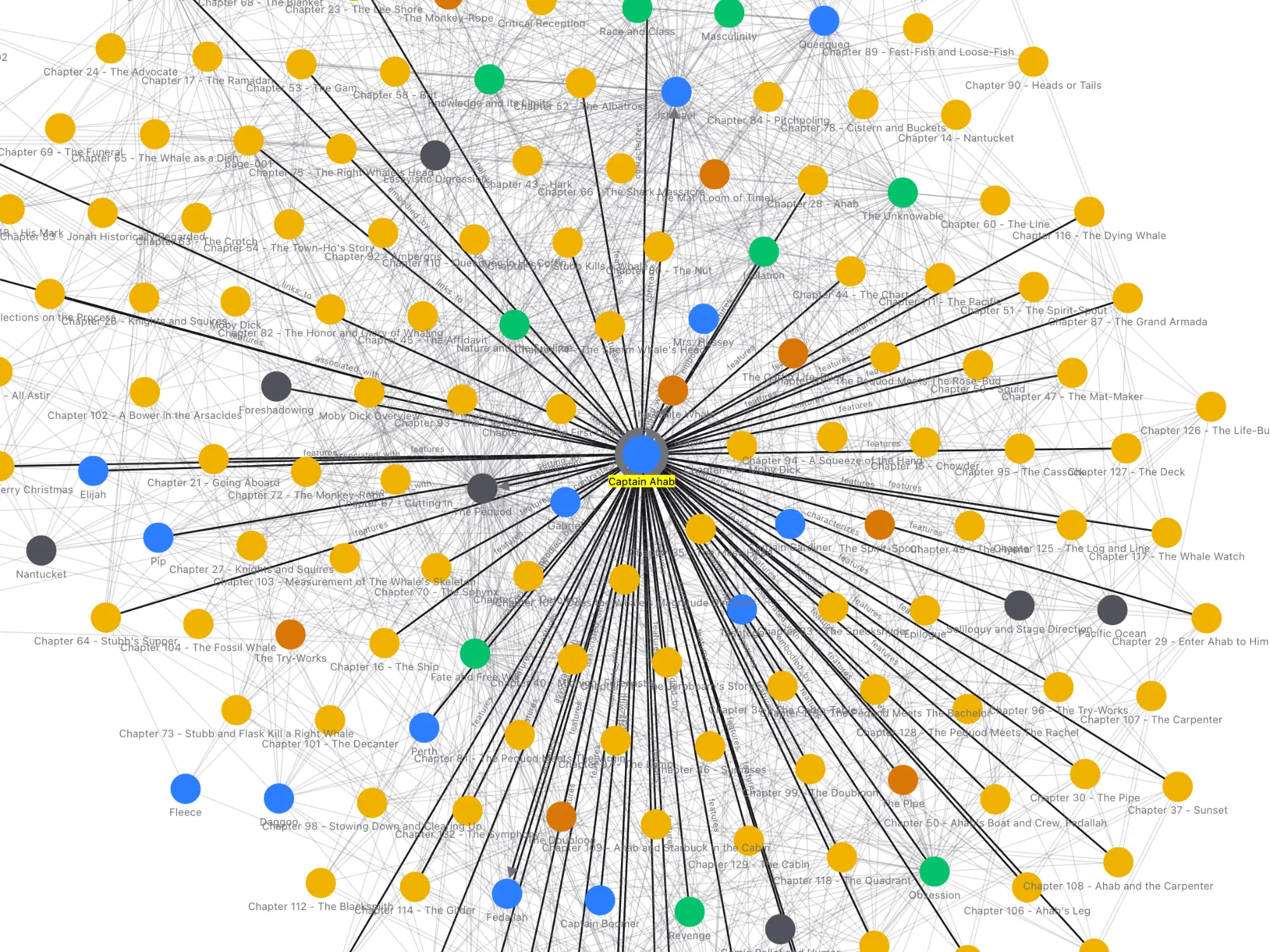
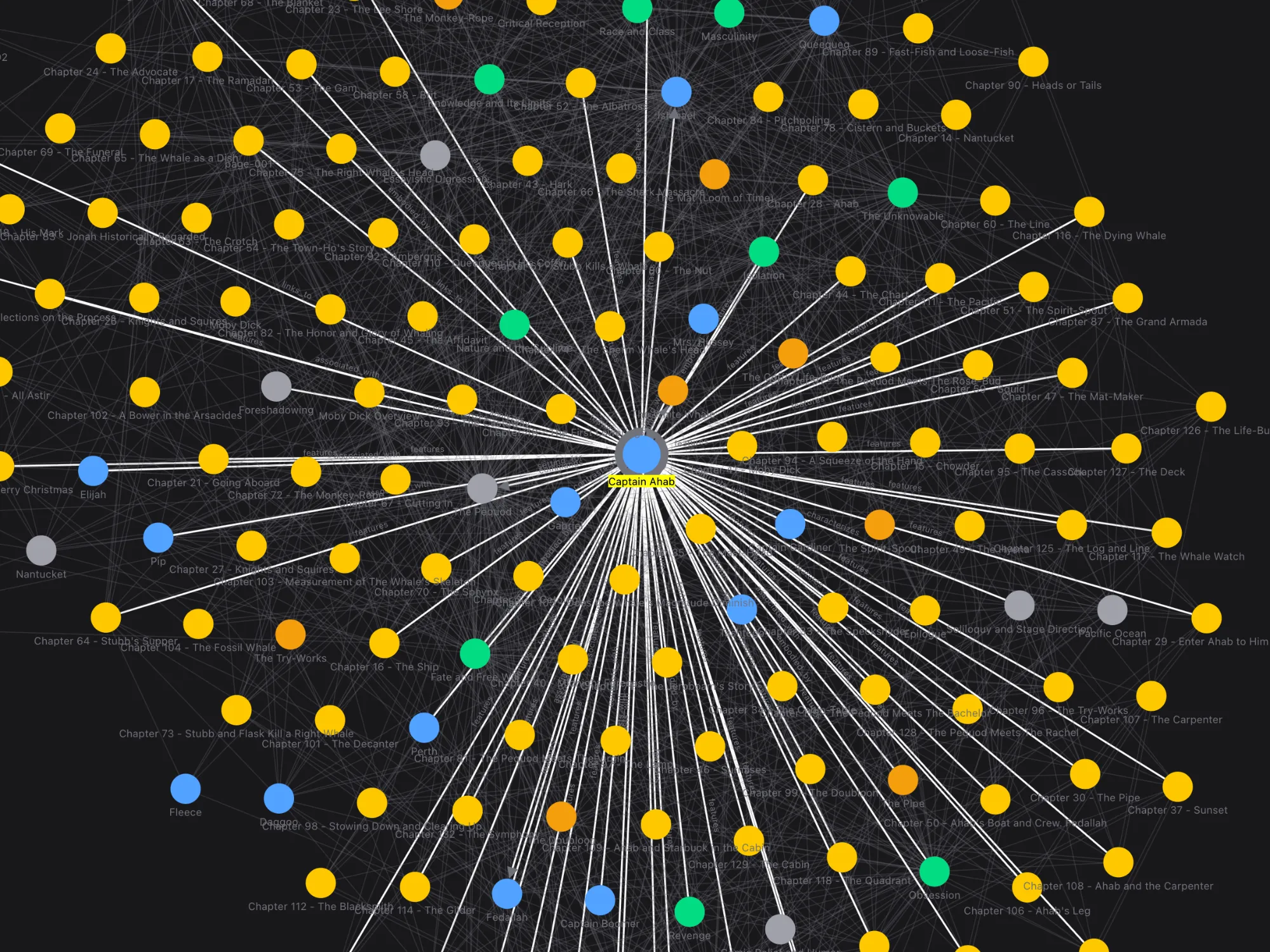
Captain Ahab at the center of the Moby-Dick knowledge graph. Every gold node is a chapter that features him; every blue, green, and grey node is a character, theme, or symbol he relates to. Click any of them and the graph re-centers. This is the shape your AI walks when you ask a question that spans the whole work.

Full Moby Dick knowledge graph in the Basic Memory web app, with Captain Ahab at the center connected to dozens of chapters, characters, themes, and symbols
From the analysis

What this kind of memory unlocks

Ahab is the greatest tragic figure in American literature — a claim I make without qualification. What makes him inexhaustible is that he is simultaneously right and wrong. He is right that the universe operates through masks, that something vast and possibly malevolent lurks behind the surfaces of things. He is wrong that it can be fought.

Opening paragraph of the Captain Ahab note in the moby-dick project. The literary judgment is the human-and-AI synthesis. The fifty chapter-attributed observations underneath it are what make it queryable. Together they are a thinking partner that has actually read the book.

## FAQ

Common questions.

How do I analyze a large document or corpus with AI?
Define schemas for the entity types you care about (for a novel: Character, Theme, Chapter, Symbol, Location, LiteraryDevice). Seed stubs for major entities. Process the source chapter-by-chapter in batches; per chapter, write a chapter note and append observations to every related entity. Cross-reference at the end. The result is one navigable knowledge graph you can query across the whole corpus. We built exactly this from the full text of Moby-Dick (~215K words, 135 chapters, ~220 notes, ~1,800 relations).
How is this different from asking an AI to summarize?
A summary is lossy and ephemeral. A Basic Memory knowledge graph keeps every entity, relation, and supporting quote as plain Markdown you own. The AI can answer questions that span the entire body of material ("how does Ahab's monomania evolve from Ch. 36 to Ch. 132?") by walking the graph instead of recalling fragments, and you can inspect, extend, and re-analyze the model later.
Can the same approach work for other kinds of long-form material?
Yes. Swap Chapter for Section in non-fiction, Act/Scene for plays, Poem for a poetry collection. The pattern (six or so schemas, seed major entities, process in batches, cross-reference, validate) adapts to any long-form corpus. The literary-analysis skill documents the variations.

Try this playbook.

Free and open source to run locally. Two minutes to connect your first AI tool.